

Before you begin
You need access to the document. Viewing older revisions, changing keywords, uploading revisions, and editing content can require additional rights. A copied link does not grant access. For access problems, see document access rights.Open the document
- Find the document in Search and select its row to show the preview.
- Check the document name, ID, type, and keywords. Similar filenames can refer to different records.
- Use Open in new page when you need more room; it opens the document in a new browser tab. Hover over an action icon to read its label.
- Choose Open in redaction when you want to redact or annotate the document. That viewer can also appear within a Caseflow document panel.
Navigate pages and adjust the view
The exact controls depend on the preview format. In the redaction and annotation viewer: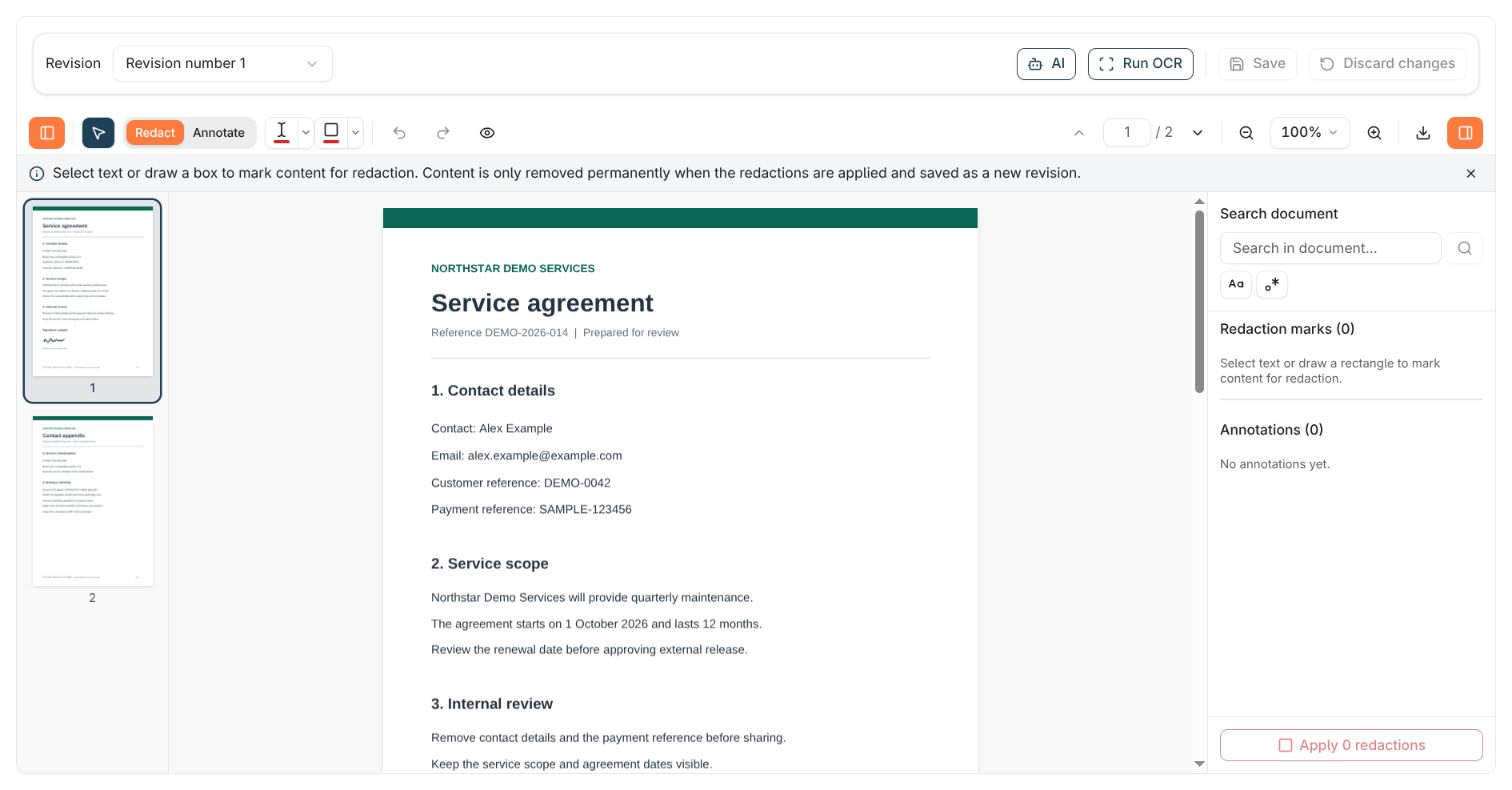
Use page thumbnails, the page-number field, and zoom controls to inspect the whole document. Screenshots use fictional local sample data.
Check revisions, renditions, and history
A revision is a stored version of the document. A rendition is a file representation of a revision, such as a PDF. Select the intended revision and, where available, its rendition before reviewing or downloading it. Use Show history to inspect available revision and document-history information. Check the revision number, date, author, and comment to understand which version you are reading. Opening an older revision lets you inspect that version; it does not by itself restore it as the latest one. The redaction viewer has its own Revision selector and opens the latest revision initially. Saving annotations, reviewable marks, or an applied redaction result creates a new revision. Earlier revisions remain available according to access rights. Save an applied working result before switching versions if you need to retain it. If the viewer reports another active editor or a newly created revision, check whether loading it would discard your current work. See leaving or changing revisions during redaction.Choose the document action
OCR and document questions
In the redaction viewer, Run OCR can add recognised text to a PDF so you can select and search it. Check the result against the visible page; OCR is not a verification of the document’s accuracy. When AI redaction is available, you can ask questions about the open document or request text to be marked. Check answers against the source and review every suggested mark. See AI-assisted redaction. AI search and chat elsewhere have their own search workflow.Check the outcome
After changing content or metadata, reopen the relevant document or revision and verify what was stored. After downloading, open the actual file. After copying a link, remember that its recipient sees only what their own rights allow, which may include earlier revisions if they have revision access. If an action is unavailable or fails, record the document ID, chosen revision, action name, and reported message. Check access and file-format support before repeating a write or upload; a successful save followed by a failed reload can otherwise produce duplicate revisions.Where to read next
How to redact a document
Mark sensitive text and areas, apply the redactions, and save and verify a PDF before sharing.