

Before you begin
You need access to Open in redaction, permission to view and create revisions, and a document type that allows revisions. If your file needs conversion or OCR, follow Open and prepare the document first. Screenshots below use the same fictional service agreement as the redaction walkthrough.Choose an annotation tool
Open the document with Open in redaction, then choose Annotate. Hover over a tool to see its name and instructions. Use the colour button beside a tool to choose its colour before placing an annotation.
The current toolbar does not offer a stamp tool. A handwritten ink mark or typed callout is an annotation, not a document approval or signature workflow.
Highlight a clause and add a note
1
Highlight the text
Choose Highlight and drag across the relevant words. In the example, highlight the sentence stating the start date and 12-month term. Check that the highlight covers the intended phrase.You can also use Select and choose Highlight, Underline, or Strikeout in the selection popup. If the text cannot be selected, use OCR or an area/freehand tool.
2
Place a sticky note
Choose Sticky note, click beside the clause, and enter a useful instruction such as “Confirm the renewal date before external release.” Choose OK to place it.Use a Callout instead when you want the comment shown as text connected to a point on the page. Place comments where they leave the underlying document easy to read.
3
Review the annotation list
Open the right sidebar and choose Annotations to focus the list. Select an entry to jump to its page. Check the highlighted clause and note together, then correct any mistake before saving.
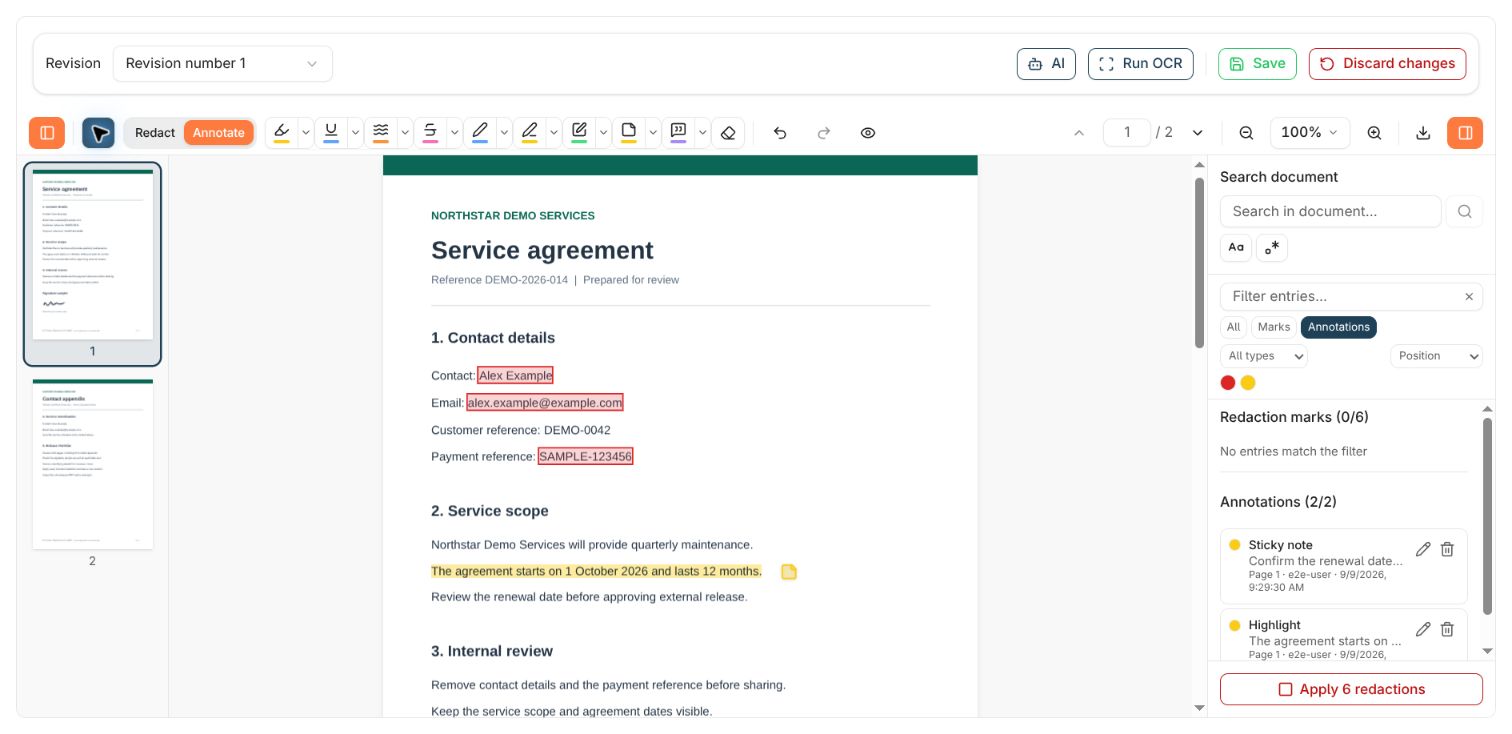
A highlighted agreement term and a sticky note give the next reviewer a specific action. The sidebar is filtered to Annotations.
Edit comments, colours, and mistakes
Use Select and click an annotation to open its controls. You can also select its sidebar entry. Hovering over an item can show its comment and author information.- Choose Edit note, change the comment, and choose the small Save button in the note editor. This updates the local note; use the top-bar Save afterwards to store the document revision.
- Use an annotation’s colour controls when available. Tool colours apply to new annotations; select an existing annotation to change that item.
- Use Delete annotation, Eraser, or Delete/Backspace with the item selected to remove an editable item. In a text field, those keys edit text instead.
- Use Undo and Redo for local editing mistakes. If a drawing or area is in the wrong place, remove it and draw it again.
Review a document with many annotations
Use Filter entries… to find an existing entry by its comment, covered text, or author. All, Marks, and Annotations choose which kinds of entries you see. Author, annotation-type, and colour controls appear when relevant; combined filters narrow the list further. Sort entries changes the list order to Position, Newest first, Author, or Type. Position follows the document’s reading order. Selecting an item on the page keeps its entry reachable even when a filter would otherwise exclude it. Hide annotations temporarily hides annotation overlays so you can read the page underneath; Show annotations brings them back. This does not delete the annotations or change which ones are saved or downloaded. Clear filters and restore visibility for the final review.Save or download the annotated version
- Choose Save in the top bar.
- Add a revision comment when prompted and confirm Save. A comment may be required by the document type.
- Wait for Annotations saved successfully and check the new revision number.
- Reopen that revision and check that the annotations are present.
Keep document notes and PDF annotations separate
A Sticky note or annotation comment belongs to the PDF review and can travel with Download with annotations. The document’s Notes panel is a separate conversation in Nobly Insight, with features such as replies, mentions, and following. Use document notes for team discussion and notifications. Before sharing a redacted file, check annotation comments, callout text, and author information for sensitive details. Avoid repeating a value you are trying to remove. If saving reports Notes contain text that is being redacted, edit the offending content rather than retaining it in a release copy.Where to read next
How to update document keywords
Correct the indexing metadata stored with the document and verify the saved result.
How to redact a document
Remove sensitive content, apply the marks, and check a release copy before sharing.